Ducks, geese, and swans · Waterfowl
Ruddy Shelduck
Link copied.
Tadorna ferruginea
Link copied.
Voice
Call
Call
How to recognize it
-
Length 61–67 cm
-
Ruddy orange body, paler head
-
In flight, white wing patches and black flight feathers
-
Male with a black neck ring in summer; female usually with a white patch on the head
About the species
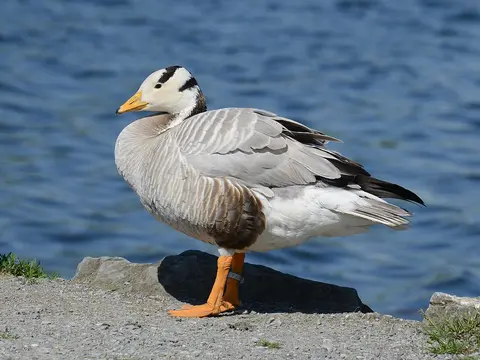
Rust-orange feathers cover most of the Ruddy Shelduck, paling to buff on the head and neck. In flight, broad white patches show across the wings against black flight feathers and a black tail. A breeding male has a narrow black collar, while the female has a pale patch on the side of her head.
A loud, nasal honk carries from the ground or overhead. Usually in pairs or small groups, they feed mainly at dusk and at night, grazing on land or dabbling in shallows; in deeper water, they tip forward rather than dive. Pairs stay close and drive intruders away during the breeding season.
Open lakes, reservoirs, slow rivers and ponds provide feeding and resting places. They eat grasses, grain, water plants and small invertebrates. Many Asian populations move south for winter, with some reaching the Indian subcontinent, while Moscow’s feral park-pond population stays on unfrozen water.
Did you know?
-
Africa's only Europe-bound migrant
Of the roughly 2,500 ruddy shelducks breeding in northwest Africa, up to 200 once wintered in southern Spain. They are only African nesting species known to migrate north into Europe.
Link copied.
-
Nesting in attics
Moscow's ruddy shelducks pick nest sites in parks and on ponds — and also in the attics of apartment buildings right in the city.
Link copied.
-
Paired for life, every season
Ruddy shelducks pair for life: the male and female stay faithful to each other to the end and keep together through every season.
Link copied.
Where to find
-
At ponds in Moscow parks, look for Ruddy Shelducks among mallards; they usually stay in pairs and remain around unfrozen water in winter.
-
At open lakes, reservoirs, and rivers, watch for feeding in the shallows with heads dipped into the water, and tail-up feeding in deeper water.
-
In spring, scan green lawns for ground-feeding among young shoots and seeds.