Hawks and eagles
White-tailed Eagle
Link copied.
Haliaeetus albicilla
Link copied.
How to recognize it
-
Body length 70–90 cm
-
Adults: brown body, pale buff head and neck, short wedge-shaped white tail
-
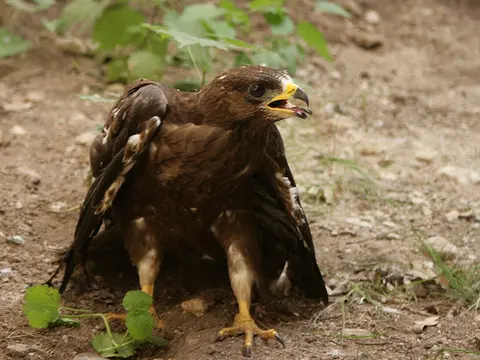
Juveniles: dark brown, with whitish mottling below; tail greyish cream
-
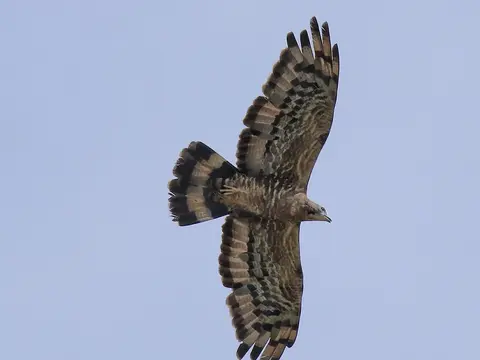
In flight, very broad wings with spread feather tips, held flat or slightly raised; often soars
About the species
An adult has a brown body and broad wings, with a paler buff head and neck. Its short, wedge-shaped tail is white, while the large yellow bill and feet contrast with the darker plumage. Young eagles are much darker brown, with pale edges on some feathers, and take several years to acquire the adult’s pale head and white tail.
For long stretches it sits upright on a tree or rock, sometimes barely moving for hours, then soars over water on broad wings. During the breeding season, pairs call back and forth with repeated “krick-krick-krick” notes, sometimes calling together as they fly.
It stays near large bodies of water, from coasts and estuaries to inland lakes, wetlands and rivers, nesting in mature trees or on cliffs. Fish and waterfowl are major foods, but it also takes other available prey and scavenges carrion. Many adults stay close to their breeding areas year-round, while young eagles often disperse farther south; populations in parts of Russia migrate more regularly.
Did you know?
-
Abandons the clutch after a visit
Even a routine check of the clutch by a human often ends with the eagles abandoning the nest — that's how panicked their reaction to people can be.
Link copied.
-
Hounds other birds till they drop the fish
The White-tailed Eagle turns pirate: it spots Ospreys, gulls and cormorants flying with a catch and harries them until they drop the fish, which it then collects.
Link copied.
-
Raids the Osprey's conspicuous nests
The White-tailed Eagle holds an ecological niche close to the Osprey's and crowds out its weaker neighbour — raiding the Osprey's conspicuous nests.
Link copied.
Where to find
-
In Denmark, at protected waters on city outskirts, look up for long stretches of soaring over the water.
-
At shallow lake and river edges, watch for a short flight from a perch and a strike at a fish.
-
In winter on the Baltic coast, scan trees and steep island slopes for immature white-tailed eagles roosting in groups.
-
At commercial fish farms and carp ponds, scan the banks for dead fish or fish scraps being scavenged.