Larks · Perching birds
Calandra Lark
Link copied.
Melanocorypha calandra
Link copied.
Voice
Song
How to recognize it
-
19–22 cm long
-
Brown above, white below
-
Two large black patches on the sides of the breast
-
In flight — short, broad wings, dark underneath, with a white trailing edge; short tail with white outer feathers
About the species
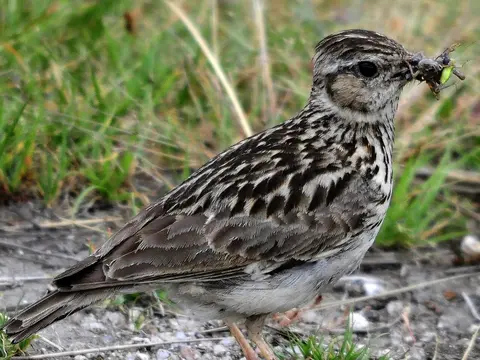
On open ground, the Calandra Lark blends into the earth tones: its grey-brown back is streaked, while the underside is pale, with two bold black patches at the sides of the breast. A pale eyebrow line gives its face a lighter edge. In flight, the broad wings look dark underneath and the short tail shows white edging.
Its song has the flowing shape of a Skylark’s, but moves at a slower pace. Outside the breeding season it gathers with others, forming large flocks in autumn and winter in parts of its range. The nest sits in a shallow hollow on the ground, often tucked beneath a grass tussock.
It lives in open steppe, pastures and dry cultivated fields, especially fallows and field edges. It feeds mostly on insects in summer, then seeds and grass shoots in winter. Mediterranean populations are mainly resident, while those in Russia move south for winter, sometimes reaching the Arabian Peninsula and Egypt.
Where to find
-
Outside town, on dry pastures in summer, look for Calandra Larks searching for insects on the ground among the grass.
-
Along fallows and field edges in winter, watch for feeding on seeds and grass shoots.
-
On dry pastures and cultivated fields in the Mediterranean, look for large flocks in autumn and winter.