Rails and coots · Cranes and rails
Little crake
Link copied.
Porzana parva
Link copied.
How to recognize it
-
17–19 cm long
-
Adult male: brown upperparts, blue-grey face and underparts
-
Female: buff underparts, grey only on the face
-
Male sings mostly at dawn; call "kvek-kvek"
About the species
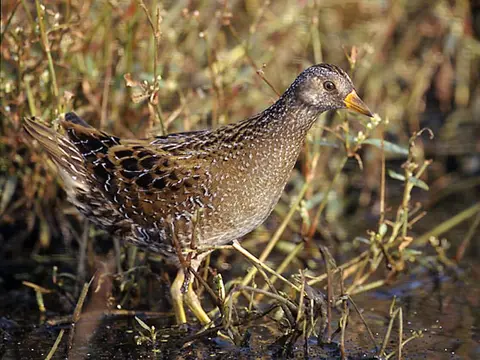
The male’s brown back contrasts with a blue-grey face and underside; the female has buff underparts, with grey confined to the face. Both have a short yellow bill with a red base and green legs. The short tail is barred black and white underneath.
During the breeding season, it stays tucked into cover and is more often heard than seen. On migration it becomes noisier and easier to spot, giving a yapping "kua" call; males also sing mainly at dawn.
It breeds in reed beds in Europe, mainly in the east, and just into western Asia. It probes mud and shallow water for insects and other small aquatic animals, and also eats tender plant shoots and aquatic seeds. After breeding, it migrates south to winter in Africa.
Where to find
-
At dawn during the breeding season, listen for the male little crake singing in the reeds — it is more often heard than seen.
-
At the reed-bed edge, scan the water for movement — it is most often seen while swimming there.
-
During migration, listen for loud, yapping calls in reed beds — it is easier to see then.
-
At muddy shallows, watch for bill movements probing the mud or water for insects and aquatic animals.