Plovers · Shorebirds
Pacific Golden Plover
Link copied.
Pluvialis fulva
Link copied.
Voice
Call
Call
Call
How to recognize it
-
About 25 cm long
-
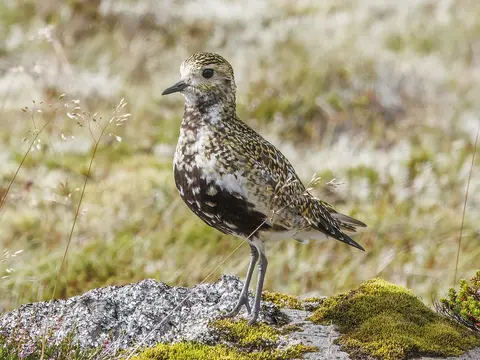
In breeding plumage, male with gold-and-black back and crown, black face, neck and breast edged in white; female’s breast mottled and less distinct
-
Outside the breeding season, both sexes have brown, gray and yellowish patterning, with paler underparts
-
Feeds in repeated runs, stops and pecks
About the species
In breeding plumage, its back and crown are flecked with gold and black, set against a black face and breast edged in white. Outside that season, the dark areas fade into mottled brown, gray, and yellow, with paler underparts. A dark bill and gray-to-black legs complete the look.
It forages with a repeated dash, stop, and peck. Many spend winter feeding alone within a territory, while others forage in loose groups; its call is a two-syllable “tyur-lee.” In Hawaii, some return to the same territory year after year.
Despite its shorebird habits, it often feeds inland in open places with short vegetation, as well as on tundra, beaches, and tidal flats. It eats insects, spiders, and other small creatures, along with berries, leaves, and seeds. It breeds in Alaska and Siberia, then migrates south to Asia, Australasia, and Pacific islands, staying until April or May.
Where to find
-
From May to July on dry, raised ground in Siberia's tundra, watch males defend their territories.
-
In western Europe, the Pacific golden plover is a rare vagrant; if one turns up on an open beach or tidal flat, watch for its repeated run, stop and peck as it feeds.
-
In Hawaiian parks and cemeteries, look for an individual returning to and defending the same territory year after year.